
Thinking of a New Land, pencils, acrylics, resin on canvas, 165 x 135 cm.

For those who crossed the Sea (2016), pencils, oil color, liquid glass, on canvas, 135×120 cm.


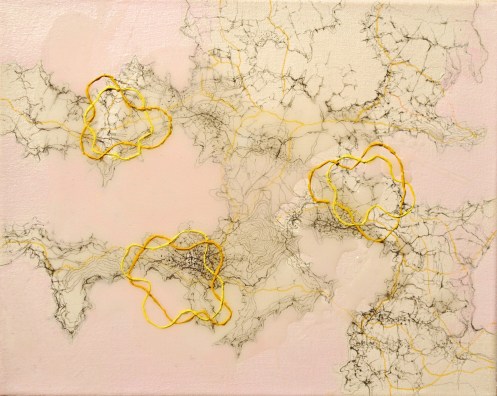
The Sea of pain (2016), pencils, oil, liquid glass on canvas, 55×45 cm
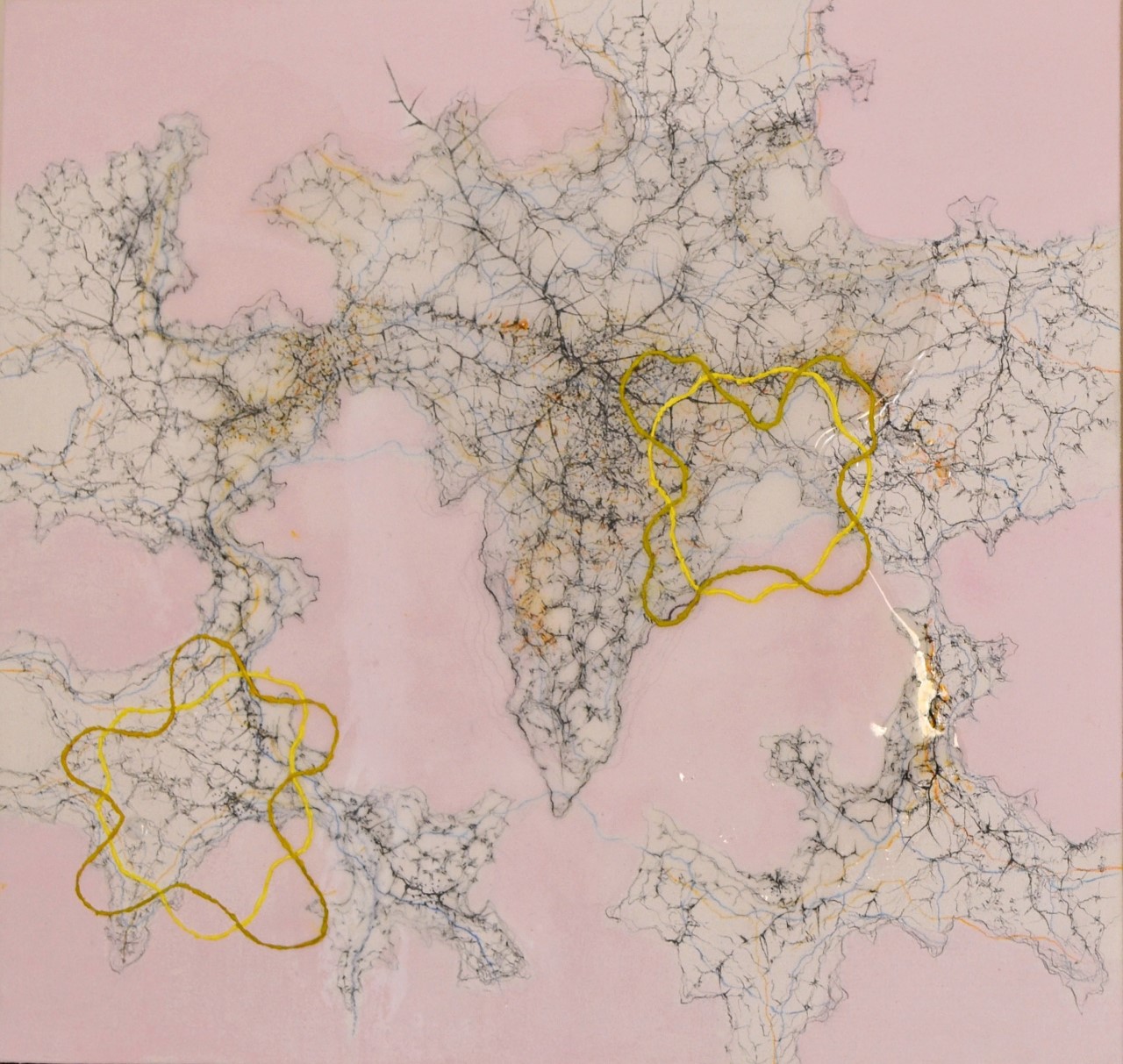
Difficult summertime stories (2016), pencils, oil, liquid glass on canvas, 55×45 cm
Personal Mapping
“Territory no longer precedes the map nor survives it. It is the
map that precedes the territory…that engenders the territory.”
Jean Baudrillard
On the wall above my desk hangs a large map entitled “The World”. It is the one I have used to study for hours and hours since my school years. It is the one that I used to plan my imagery exploring trips; India, North and Latin America, Route 66, USSR…
Since then two decades have passed. Although the outline of this “Map-form” remains the same with very little deformations, the content has radically changed.
With the collapse of European and Soviet Communism, and the thawing of the Cold War, a new order of Mapping has sought to establish itself. With the physical and political fall of the Wall, the map we knew changed. New countries came into being; no more USSR, Yugoslavia, East Germany, Czechoslovakia…and more to come. Millions of economical refugees abandoned their homelands to approach the “ex-enemy’s” land. Relating to cartography, there is a massive impact to the map. Perhaps the old East-West defense axis will be superseded by a North-South economic axis. The influence of mapping upon perception can be easily recognized. The convenient ethnographic devises of Left vs. Right may give place to these of Up vs. Down.
The power of Colonialism is taking a strange turn. In the interest of foreign investment and trade, the changing of traditional urban landscapes is readily accepted, locally. And while the natives are bewitched by the modernity and conveniences of “foreign” cultures, it is the “foreigners” who now lament the loss of native cultures.
In fact the dissolution of the Cold War, and the absence of global polarity have brought about the resurgence of national and local identities. And although much of neo-Nationalism may be impelled by the political and financial ambition of the few, the new map (neo-Map), nevertheless, seems quintessential to the self-identity of the indigenous mass.
The recent body of work is informed by a wide variety of sources ranging from architectural drawings, city maps, and satellite pictures, computer graphics and stitching. Form and line are embraced, reminding us something of a landscape, map and routes, fragile laceworks, cotton threads and strings.
The relationship to memory sometimes remains strong even if we consider these drawings solely as maps of imaginary lands. body of work is simplified further and brings together my concerns in drawing using line, exploring at the same time, new drawing methodologies and the challenge in practicing cartography. The new paintings explore the territory of Personal-mapping and investigate the viability of the line as a medium, in relation to my practice.
The forms of my imaginary maps, my ideal space, are result of the imagination. They are pictorial collages of fragments of imaginary aerial land observations, layered under an organic grid structured by a chaotic spinning line in motion; these nets of line emerging from the cells of my emotional and visual memories. This body of work employs a complex of imaginary symbols, stitching cartographical marks and fragments generating a macro and micro-topographies in drawing.
However, while my Personal-Maps, as works of art, can be enjoyed without any knowledge of cartography, they still may offer some inspiration to the map-enthusiast.
 Yiannis Christakos Art